
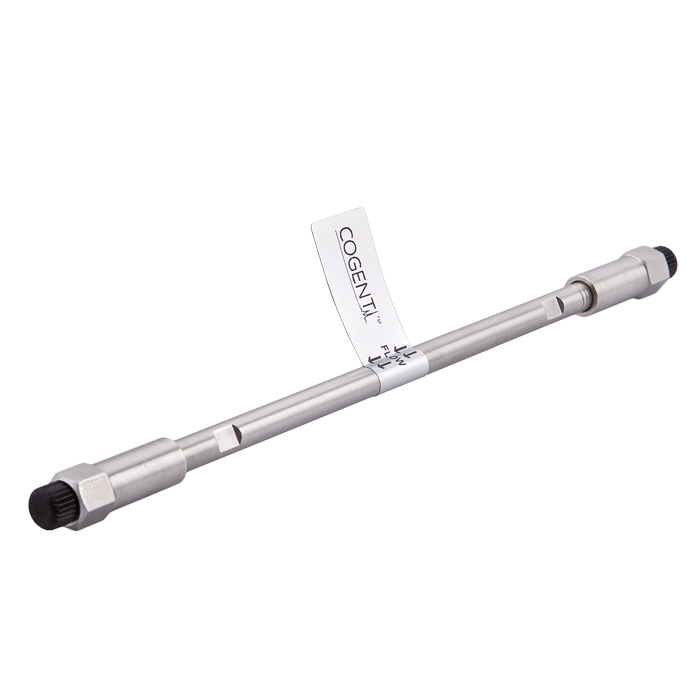
CUSTOM ITEM: HPLC Column, Bidentate C8 300, 5um, 2.1mm ID x 150mm Length, 300A. Cogent TYPE-C Brand. 1 EA.
Additional Information:
The 40008‑15P‑2‑3M Cogent Bidentate C8™ 300 HPLC Column is a custom‑manufactured, long‑format wide‑pore reversed‑phase column designed for high‑resolution analysis of macromolecules, including proteins, peptides, polysaccharides, and other large biomolecules. Built on Cogent TYPE‑C™ silica hydride technology, this column provides excellent selectivity, faster equilibration, and extremely robust column lifetime compared with conventional 300 Å silica‑based C8 columns.
The stationary phase employs an aliphatic C8 hydrocarbon chain bonded via direct silicon–carbon bonds to a silica hydride surface. This chemistry produces a phase that is more hydrophobic than traditional wide‑pore C8 columns, yet appropriately balanced for biomolecules—delivering strong, controlled retention without the excessive adsorption often observed with wide‑pore C18 phases. The 300 Å pore architecture ensures efficient analyte access and mass transfer for large molecules, improving peak shape and resolution.
Unlike typical wide‑pore C8 materials, Bidentate C8™ 300 can retain compounds that often show weak or inconsistent behavior on standard silica phases. The column can also retain select hydrophilic macromolecules, particularly when operated in HILIC‑like modes, and is stable at very low pH (below pH 2) without degradation—significantly expanding method flexibility.
The 2.1 mm internal diameter supports low‑flow operation, reduced solvent consumption, and enhanced MS sensitivity, while the extended 150 mm length provides the highest resolving power in the Bidentate C8™ 300 narrow‑bore lineup. As a result, this column is often chosen for LC‑MS workflows when increased resolution for large molecules is required beyond what 50 mm or 100 mm formats can deliver.
Why Choose the 2.1 × 150 mm Bidentate C8™ 300 Format
This configuration is typically selected when:
Analytes are large biomolecules requiring 300 Å pore access
Conventional wide‑pore C8 columns lack sufficient resolution or stability
Excessive adsorption on wide‑pore C18 must be avoided
Maximum analytical resolution is required for LC‑MS of macromolecules
Low‑pH operation is necessary without column damage
The combination of long length, wide pores, and TYPE‑C™ silica hydride chemistry delivers separation performance that conventional wide‑pore silica columns cannot match.
Key Features
Cogent TYPE‑C™ Silica Hydride Technology
Direct Si–C bonding for exceptional chemical robustness
Reduced silanol activity and secondary interactions
Faster equilibration than conventional wide‑pore silica columns
Bidentate C8™ 300 Bonding
Enhanced hydrophobicity vs standard C8
Balanced retention for proteins and other macromolecules
Avoids excessive adsorption associated with C18
Wide‑Pore (300 Å) Architecture
Optimized for proteins, peptides, and polysaccharides
Improved mass transfer and peak shape
Effective macromolecular separations
Maximum‑Resolution Narrow‑Bore Geometry
2.1 mm ID × 150 mm length
Highest resolution among narrow‑bore C8™ 300 options
Ideal for demanding LC‑MS biomolecule workflows
Aggressive Method Compatibility
Stable at very low pH (below 2)
Compatible with aqueous‑rich mobile phases
Supports alternative HILIC‑like operation for select macromolecules
System Requirements
For optimal performance with this long, narrow‑bore wide‑pore column:
Use an LC pump capable of accurate, stable low‑flow delivery
Employ detector flow cells designed for low internal volume
Ensure LC‑MS systems are configured for biomolecular analysis
Typical Applications
LC‑MS of proteins, peptides, and polysaccharides
High‑resolution macromolecule characterization
Wide‑pore reversed‑phase separations
Biomolecule method development
Low‑pH protein and peptide analysis
Alternative HILIC‑mode macromolecule workflows
Made‑to‑Order & Pricing Information
This is a custom, made‑to‑order item.
Orders cannot be canceled once placed
Custom items are non‑returnable